Ankle sprain · 30 October 2026
Ankle sprain: four reasons it keeps giving way
An ankle sprain keeps giving way when it was treated as just a twist, when balance and strength were not trained, or when an associated injury was left that nobody looked for. It is treated with ultrasound in clinic, a strength and balance programme and, if the ligament does not heal, autologous growth factors. Dr Julio De la Morena treats it at the Regenerative Therapies and Sports Medicine Unit of Hospital Memorial Publio Cordón (Pozuelo de Alarcón, Madrid).
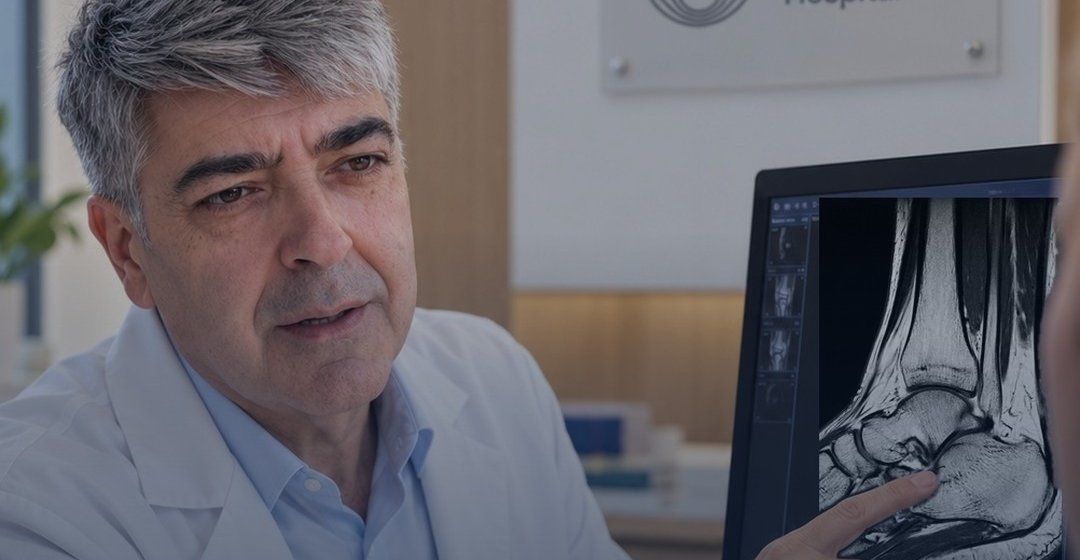
“Since that sprain, my ankle has never been the same”
It is something heard in clinic every week. The ankle sprain is one of the most common injuries and, at the same time, one of the most poorly healed. It happens when the foot twists, almost always inwards, and damages the ligaments that stabilise the joint, in most cases those on the outer side.
It can happen to anyone: stepping off a kerb, missing a step on the stairs or during a match. Most sprains recover well with functional treatment, but when recovery is incomplete it leaves an unstable ankle that keeps rolling over. These are the four most common reasons.
1. It was treated as “just a twist”
A significant sprain without a diagnosis can leave the ligament lax. Not all sprains are the same: the examination determines which ligaments are affected and whether an X-ray is needed to rule out a fracture, and ultrasound shows the state of the ligament and grades the injury. Without that diagnosis, it is easy to return to activity too early or with a treatment that does not match the real severity.
2. Balance was not trained
After a sprain, the ankle loses its ability to “know where it is”, that is, to sense its position and react in time to a bad step. Without specific balance work, that ability does not recover properly and the ankle rolls over again in everyday situations.
3. The leg lacks strength
The muscles that stabilise the ankle must recover before returning to normal life, and also before returning to sport. More than the time that has passed, what matters is having recovered strength and balance. If you return with weakened muscles, the ligament is left unprotected.
4. An associated injury was left behind
In a sprain, besides the main ligament, the cartilage, tendons or other ligaments can be damaged at the same time. If that associated injury is not looked for, the ankle keeps hurting or giving way even though the sprain seems healed. Ultrasound in clinic helps to uncover it.
How we approach it
A poorly healed sprain can be treated. The approach in clinic includes:
- Ultrasound in the same appointment to assess the state of the ligaments and look for associated injuries.
- A strength and balance programme to restore ankle stability and prevent further re-injury.
- Autologous growth factors if the ligament does not heal, applied by ultrasound-guided injection. They are obtained from the patient's own blood (the therapy also known as platelet-rich plasma), without surgery or a hospital stay.
When chronic instability does not improve with a specific programme, the surgical option is considered. Each case is assessed individually. You will find more information on the ankle sprain page and on the ultrasound-guided injections page.
When to see a doctor
It is worth seeing a doctor if you cannot put weight on the foot or take four steps in a row, if there is significant swelling or extensive bruising, if the pain has not improved after one or two weeks, or if sprains keep happening and you feel the ankle giving way. Dr Julio De la Morena assesses these injuries at the Regenerative Therapies and Sports Medicine Unit of Hospital Memorial Publio Cordón, in Pozuelo de Alarcón (Madrid).
Frequently asked questions
Which doctor treats a poorly healed ankle sprain in Madrid?
Dr Julio De la Morena, specialist in Sport and Exercise Medicine, treats ankle sprains and unstable ankles at the Regenerative Therapies and Sports Medicine Unit of Hospital Memorial Publio Cordón, in Pozuelo de Alarcón (Madrid), with ultrasound in the same appointment.
Why do I always twist the same ankle?
It is usually due to a previous sprain that did not fully recover: a ligament left lax, balance that was not trained, a lack of strength in the leg or an undiagnosed associated injury.
Can an old sprain be treated?
Yes. It is assessed with ultrasound, a strength and balance programme is prescribed and, if the ligament does not heal, autologous growth factors may be used. If the instability persists, surgery is considered.
When can I return to sport after an ankle sprain?
It depends on the grade: from one or two weeks for mild sprains to several weeks for severe ones. More than time, what matters is having recovered strength and balance before returning.
Do you recognise yourself in what you have just read?
Examination and ultrasound in the same appointment: you leave with a diagnosis and a plan. The first consultation does not commit you to any treatment: if it is not indicated, we will tell you.
Hospital Memorial Publio Cordón · Pozuelo de Alarcón · +34 913 548 990 · Monday to Friday, 15:00 to 21:00

Article by Dr Julio De la Morena Garzón, specialist in Sport and Exercise Medicine (medical registration no. 281903698). General information that does not replace a medical consultation.